From «Neighbourhood first» to «Neighbourhood lost»? India’s foreign policy towards South Asia under Modi
Available also in pdf – Download Pdf
This paper examines the trajectory of India’s «Neighbourhood First» policy under Prime Minister Narendra Modi (2014-2025), analysing its underlying drivers, implementation, and implications. While India’s geographic centrality and strategic self-perception position it as a key player in South Asia, critics argue that there is a widening gap between India’s rhetorical commitment to regional engagement and the actual substance of its neighbourhood diplomacy. This paper investigates this puzzle by identifying in the China challenge, status-seeking ambitions, domestic political agendas and identity politics and border disputes, the four key drivers of India’s engagement in South Asia. In doing so, it argues that India’s foreign policy in South Asia is marked by a struggle to sustain regional primacy against China’s economic inroads and its own ideological constraints. Through an analysis of official speeches, academic literature, newspapers as well as policy reports, the paper provides an empirical survey of India’s relations with Afghanistan, Bangladesh, Bhutan, Maldives, Nepal, Sri Lanka and Pakistan. Understanding the trajectory of India’s neighbourhood policy under Modi offers critical insights into the country’s evolving international posture, its willingness to assume regional leadership, and the potential constraints on its global ambitions.
Keywords – India; South Asia; China-India; rising powers; Pakistan; Bangladesh; Maldives; Sri Lanka; Afghanistan; Nepal.
1. Introduction
The swearing-in ceremonies of Indian Prime Minister Narendra Modi have been closely observed for the diplomatic signals that they display. In 2014, the headlines were all for the presence of leaders from the South Asian Association for Regional Cooperation (SAARC). Notably, then Pakistani Prime Minister Nawaz Sharif attended the ceremony, a first in the two countries’ history since independence [BBC 2014]. 5 years on, at the ceremony in 2019, most regional leaders were again present, this time with the important exception of Pakistan (following the post-Pulwama border skirmishes earlier in the year). In 2024, the tradition of inviting leaders from South Asia continued (as it did the absence of Pakistan), this time including leaders from the Indian Ocean region, highlighting New Delhi’s attempts at deepening its regional outreach. Following the ceremony in 2024, Modi reaffirmed India’s commitment to its «Neighbourhood First» policy and «Security and Growth for All in the Region» (SAGAR) vision, stating that India would continue working for «peace, progress and prosperity of the region in close partnership with these countries» [Laskar 2024]. As these three snapshots suggest, the presence of South Asian leaders at these inaugurations signals, at least nominally, the centrality of regional engagement in Modi’s foreign policy.
This shouldn’t be surprising. Looking at the map of South Asia, the region includes India and six countries that share a border with India but not with one another (with the exception of Pakistan and Afghanistan) [Jacob 2024]. The geography of the sub-continent thereby highlights the centrality of New Delhi in the region’s geopolitics, which has long informed India’s strategic self-perception. As Aparna Pande [2011] noted, there is a sense that India must be «the arbiter of its own destiny, and the region’s». Such a vision is echoed by many in India who view the subcontinent as a cohesive entity with New Delhi as its natural leader [Mohan 2022].
Despite the self-perceived centrality of India in the sub-continent and Modi’s «Neighbourhood first» initiative, critics opine that there is a disconnect between rhetorical commitments to regional leadership and the reality of the Indian government’s actual engagement with the region. They contend that Modi’s administration has prioritised the country’s global ambitions and the domestic consolidation of a Hindu nationalist agenda over substantive regional engagement. As Congress MP P. Chidambaram remarked, the government’s approach has shifted from «Neighbourhood First» to what some now describe as «Neighbourhood Last or Neighbourhood Lost» [Indian National Congress 2024].
In exploring this puzzle, the paper answers the following questions: what are the drivers of India’s «Neighbourhood First» policy? How effective has India’s engagement with South Asia been under the prime ministership of Narendra Modi? These questions are important not only because they interrogate India’s regional credentials as a rising power, but also because they illuminate broader strategic implications for Western policymakers. Understanding the trajectory of India’s neighbourhood policy under Modi offers critical insights into the country’s evolving international posture, its willingness to assume regional leadership, and the potential constraints on its global ambitions.
This article is divided into two parts. The first part outlines the spectrum of drivers behind India’s foreign policy, showing how they include international and domestic considerations, weaving in themes ranging from New Delhi’s relations with China and status ambitions to India’s domestic politics. Any future foreign policy decision that India takes vis-à-vis its neighbourhood is likely to emerge from this set of ideas and drivers. The second part explains how these drivers can be found in New Delhi’s engagement with its neighbouring countries, by presenting a survey of India’s ties with Afghanistan, Nepal, Bangladesh, Sri Lanka, the Maldives and Pakistan.
2. India’s foreign policy drivers: navigating status ambitions, China’s rise, and Hindu nationalism
To better understand the trajectory of India’s neighbourhood policy, it is essential to examine four major factors that influence Indian foreign policy: the relationship with China; the pursuit of international status and recognition; the influence of domestic political agendas; identity politics and unresolved border disputes While the ensuing analysis isolates these drivers for analytical clarity, they often overlap and weigh in simultaneously in charting India’s foreign policy course.
2.1. Engaging China: confrontation and cooperation
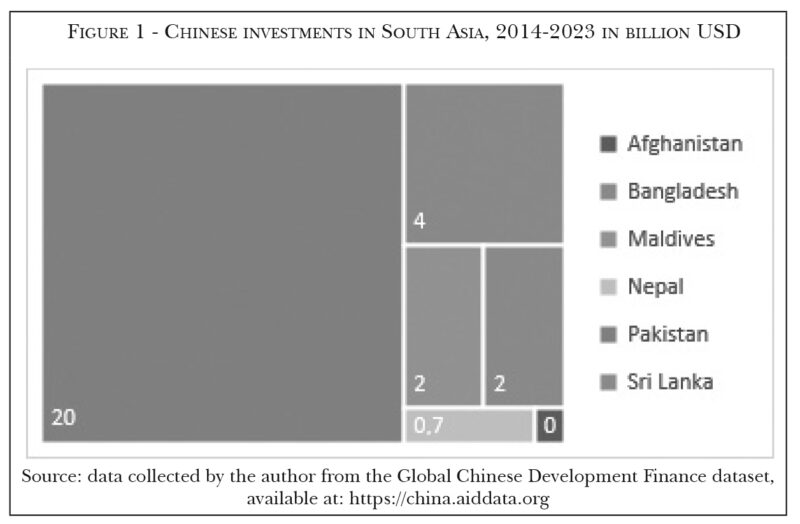
To grasp the importance of China in India’s foreign policy vis-à-vis South Asia, consider the following figures. Between 2014 (the year in which Modi was first elected) and 2023 (the latest year for which data is available), China has invested nearly 29USD billion in the South Asian region, for a total of 444 projects [Aiddata 2025]. In Pakistan only, China has invested around 20USD billion in infrastructure and energy projects that fall under the umbrella of the China-Pakistan Economic Corridor (CPEC).
The investments coming under CPEC are the ones that have attracted the most attention as well as India’s staunch opposition. A December 2018 survey of India’s strategic community revealed that 73 percent of respondents considered CPEC a major security threat, with 63 percent also concerned about Chinese influence in neighbouring island nations [Jaishankar 2019, p. 12; Iwanek 2019, 8 April]. India’s objections to Chinese investments in Pakistan stem from three main concerns. Firstly, the corridor passes through Gilgit-Baltistan, a territory that is part of the contested Kashmir region, thereby infringing, in New Delhi’s view, on what India considers its sovereign territory. Secondly, Indian policymakers see the development of the Gwadar port under CPEC with concern, fearing it could eventually serve as a Chinese naval outpost in the Arabian Sea, giving Beijing a strategic military foothold near Indian waters and close to the port of Chahbahar in Iran, managed by India [Boni 2023a]. Thirdly, India perceives China’s expanding presence in South Asia, including in countries like Sri Lanka and the Maldives, as a challenge to regional stability.

On top of China’s increasing economic influence in the sub-continent, the unresolved border dispute between India and China represents an ongoing concern for New Delhi, despite attempts between 2024-2025 to mend fences between the two. Tensions between China and India reached their peak in 2020 during the clashes in Ladakh, which many analysts view as a turning point in New Delhi’s foreign policy [Maiorano 2023; Torri 2022]. According to Ian Hall, the Galwan incident marked a pivotal moment that led India’s External Affairs Minister S. Jaishankar to recalibrate India’s stance, from traditional non-alignment to seeking deeper strategic ties with Western powers in attempt to balance the rise and assertiveness of China [Hall 2025]. Proponents of this viewpoint suggest that evidence of this can be found in India’s strengthening of its security and cooperation ties with the United States, Australia, and Japan through the Quad entente, which now serves as an important platform for India to balance China’s influence in the Indo-Pacific region.
Such a view of closer alignment with the West with an eye on China is however mitigated if we take into account the substantial economic relations between New Delhi and Beijing. In 2024/25, China became India’s second-largest trading partner, with bilateral trade reaching US$ 127.7 billion, just behind the United States [Kumar 2025]. Between 2014 and 2022 (the latest year for which World Bank data is available), China had the largest share of imports in India with an average 15% percent, while having only 4.6% share of India’s total exports [World Bank 2025]. Moreover, India’s rising exports of electronics goods, pharmaceuticals and engineering goods are also fuelling imports from China, due to their heavy dependence on imported components [Kumar 2025]. These dynamics are important for two reasons: first, they demonstrate India’s reliance on imports from China of components and raw materials for its industrial development; second, they suggest that these economic considerations, coupled with the country’s long-standing preference for strategic autonomy, will likely limit the extent of India’s alignment with the West against China [Bajpaee and Jie 2025].1
2.2. International status ambitions
Closely linked to the dynamics of China-India relations is India’s enduring pursuit of major power status, a constant theme in its foreign policy since independence. Strengthened by its economic growth over the past two decades, India today has embarked in what T.V. Paul [2024] described as an «unfinished quest» for global recognition. While India’s centrality in the Indo-Pacific has brought it closer to the US (at least until the advent of the second Trump administration), its foreign policy actions simultaneously represent an attempt at challenging the Western-dominated global order. This challenge is articulated around membership in international organisation (e.g. Shanghai Cooperation Organisation) and groupings (e.g. BRICS) as well as in India’s repeated calls for reforms to international institutions to better reflect the growing influence of emerging economies [Maiorano, 2023]. In the words of Subrahmanyam Jaishankar, the Indian Minister of External Affairs, one of the rationales behind the BRICS was «a sense among very major powers that they were not getting their due place or share of global conversations and decision-making» [Jaishankar 2025]. After all, as Manjari Chatterjee Miller [2016, p. 217] notes, «a rising power is a state that increasingly globalizes by taking on responsibility in the international system, through both alliances and institutions». It is through maintaining relations with multiple global poles that India seeks to conduct its foreign policy. According to Jaishankar, «the country which has the maximum flexibility and the least problems is obviously better off [in a multipolar world]» [Jaishankar 2025].
In its quest for global recognition, India has adopted a two-pronged approach. First, New Delhi has engaged over the years with a growing number of multilateral and minilateral groupings, including the BRICS, East Asia Summit (EAS), Forum for India-Pacific Islands cooperation (FIPIC), India Brazil South Africa Dialogue Forum (IBSA), Quad, and SCO. Each of these provides New Delhi with the opportunity to advance or defend its interests and/or stymie others’ agendas [Hall 2023]. Importantly, many of these groupings include (and are often led by) China, but they also provide platforms in which to engage countries from the Global South [Cecchi 2025]. In addition, India has sought to position itself as a key player in the Supply Chain Resilience Initiative (SCRI), a trilateral initiative with Japan and Australia aimed at reducing dependency on China, as well as in the India-Middle East-Europe economic corridor (IMEC) [Miraglia 2025].
Second, in the last decade, India has reoriented its strategic focus from Pakistan to China and from the continental theatre to the maritime one. It has embarked on a wider economic journey by signing and negotiating several important free-trade agreements [Jacob 2024]. Amongst, the most significant one has been the free trade agreement between India and the UK, signed on the 24th of July 2025 [Webb 2025]. In addition, since 2014, the Modi government has leant more heavily into the relationships with Israel and the Gulf Cooperation Council (GCC) states of Bahrain, Kuwait, Oman, Qatar, Saudi Arabia [Boni 2023a; Blarel 2022], and the UAE, but in general it has pursued a strategy of regional «multialignment», aiming for good relations with most states in the Middle East.
2.3. Hindu nationalism and foreign policy
While wider systemic factors like China’s inroads in South Asia or India’s pursuit of great power status play a key role in determining New Delhi’s approach to the region, another significant driver of India’s foreign policy under the Modi government also lies in its domestic political agenda.
A central element shaping this agenda is the nationalist orientation of Prime Minister Narendra Modi’s Bharatiya Janata Party (BJP). Modi’s foreign policy reflects a deliberate effort to cultivate a narrative of India as an independent power, a posture which appeals to the nationalist pride of India’s political elite and the BJP’s support base, reinforcing Modi’s image as a decisive, strong leader capable of steering India toward great power status. It also reflects India’s growing consciousness of its economic strength and its desire to see that recognised [Mukherjee 2024].
Modi’s strongman politics have been reflected in more assertive postures toward neighbouring countries. Notably, the passage of the 2019 Citizenship Amendment Act (CAA), which fast-tracked citizenship for non-Muslim minorities from neighbouring states, drew widespread criticism in the region. The act was perceived as discriminatory and indicative of a broader Hindu nationalist agenda, thereby complicating India’s regional relationships with other Muslim-majority countries (e.g. Bangladesh).
At a deeper ideological level, Modi’s foreign policy is underpinned by what has been described as a form of «Hindu internationalism» [Wojczewski 2020]. This worldview draws on Hinduism’s universalist ethos to project India’s foreign policy as a natural extension of its Hindu identity, reimagining India as fundamentally a Hindu nation on the global stage [Plagemann and Destradi 2019]. The concept of Akhand Bharat, a vision of a unified Hindu civilizational space across South Asia, further underlines India’s self-perception as the region’s natural hegemon [Wojczewski 2020].
In light of these considerations, India’s foreign policy cannot be fully understood without accounting for the domestic political context in which it is embedded. Under Modi, foreign policy has become a tool for projecting internal nationalist aspirations outward.
2.4. Borders, identity and security
Identity politics and cross-border migration represent two intertwined structural features shaping India’s foreign and security policy. Population movements have been integral to India’s modern history, from the mass displacements of Partition to the 1971 Bangladesh Liberation War, during which nearly ten million refugees fled what was then East Pakistan. These dynamics are exacerbated by the porous nature of India’s borders, many of which cut directly across long-standing ethno-linguistic and religious communities. This challenge extends well beyond the Kashmir dispute or the bilateral relationship with Pakistan. Punjabi-speaking Sikh populations straddle the India–Pakistan border; Hindi-speaking Madhesi communities (including Bhojpuri and Awadhi speakers) reside on both sides of the India–Nepal frontier; Bengali communities span India and Bangladesh; and Tamil populations are divided between southern India and Sri Lanka. Such cross-border continuities produce shared identities, economic interdependence, cultural ties, and, in some cases, transnational criminal networks, complicating efforts to manage borders and contain secessionist or irredentist movements. Although successive Indian governments, including the Modi administration, have sought to mitigate these challenges through expanded border fencing and increased investment in border security forces, the underlying problems persist. Identity politics and migration thus remain enduring structural constraints on India’s ability to stabilise its periphery and project power regionally. As recent scholarship, most notably Avinash Paliwal’s work on India’s northeastern borderlands [Paliwal 2024], demonstrates, these vulnerabilities are not merely tactical or administrative but deeply rooted in the historical, social, and political geography of South Asia, making them central to any explanation of India’s foreign policy behaviour.
3. A survey of India’s ties with South Asia
Before delving into how the strategic drivers outlined above have influenced the evolution of India’s engagement with its neighbouring countries, it is instructive to examine some data snapshots. These figures suggest that, despite geographic proximity, South Asia occupies a relatively modest position in India’s broader foreign policy, both economically and politically. Economically, South Asia is characterised by persistently low levels of economic interaction and regional integration, a condition that has significant implications also for regional security and stability. Limited interdependence constrains growth and weakens the political and societal mechanisms that might mitigate interstate tensions. In the absence of substantial cross-border trade and investment, few domestic constituencies possess a material stake in the maintenance of stable inter-state relations. Looking at the numbers, only 6.9% of India’s total exports are directed toward South Asia, making it the second-lowest export destination among global regions. The import figures are even starker: a mere 0.6% of India’s total imports originate from South Asia, rendering it the least significant source of imports.2 Politically, the pattern is similar. Of Prime Minister Narendra Modi’s 91 international visits, only 16 (approximately 17%) were to South Asian countries, with just four of those occurring between 2020 and 2025. External Affairs Minister S. Jaishankar has made 17 visits to South Asia out of a total of 133 trips (13%) between 2019 and August 2025, as illustrated in Figure 2 below.

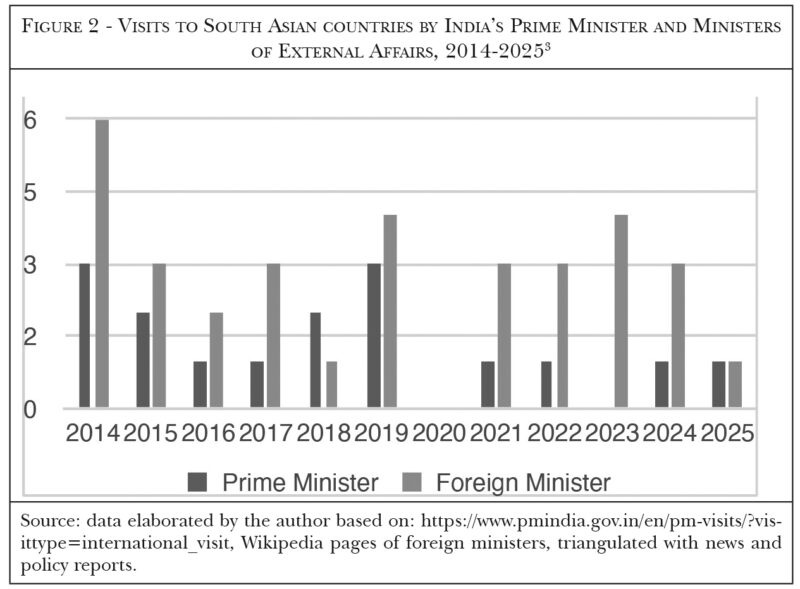
These numbers highlight a paradox: while South Asia constitutes India’s immediate neighbourhood and is often invoked in official rhetoric as central to its foreign policy vision, the region remains relatively peripheral in practice. To detail more granularly New Delhi’s engagement with the region, the paper now focuses on India’s bilateral relations with Afghanistan, Nepal, Bangladesh, Sri Lanka, the Maldives, Bhutan and Pakistan.
3.1. Afghanistan: prospects and limitations of India’s engagement
At the outset of the new Taliban era in 2021, New Delhi’s position vis-à-vis the regime was arguably the weakest among regional actors. Years of consistent support for anti-Taliban forces had hindered Indian policymakers from establishing meaningful ties with the Taliban leadership. Nonetheless, over the past four years, India’s engagement with the Islamic Emirate has seen a modest but steady progression. This trend suggests a growing recognition on both sides that a degree of engagement is necessary, and potentially mutually beneficial. The progressive engagement is symbolised first by a telephone exchange in May 2025 between India’s External Affairs Minister, S. Jaishankar, and Amir Khan Muttaqi, the Acting Foreign Minister of Afghanistan’s Taliban administration. This marked the first ministerial-level contact between the two countries since the Taliban’s return to power in August 2021 [Bhattacherjee 2025]. Second, and more importantly, Muttaqi made a week-long visit to India in October 2025. His visit was possible after a United Nations committee temporarily lifted a travel ban on him for diplomatic engagement. It was the first high-level face-to-face meeting between India’s leadership and the interim Afghan Taliban government [Ranjan 2025].
One notable area where India has sought to enhance its visibility in Afghanistan is through aid and humanitarian assistance. In March 2023, New Delhi, in collaboration with the World Food Programme, delivered 20,000 metric tonnes of wheat to Afghanistan [Kaura 2023]. Significantly, this shipment was routed through the Iranian port of Chabahar which presents a strategic alternative to Pakistan as a corridor for trade and aid to Afghanistan [Boni 2023b]. In addition, India’s annual union budgets over the past three years have consistently included special provisions for development assistance to Afghanistan [The Hindu 2022, 1 February].
The growing engagement with Afghanistan carries direct implications for India’s national security. Reports indicate that, in response to India’s outreach, the Taliban has pledged to take action against jihadist groups such as Lashkar-e-Taiba (LeT) and Jaish-e-Mohammed (JeM), which have established safe havens in Afghanistan [Bacon and Mir 2022]. These groups are the ones that New Delhi accuses of carrying out attacks on its soil. India’s diplomatic overtures also appear to aim at driving a wedge between the Taliban and Pakistan, particularly as Islamabad grows increasingly uneasy about the Taliban’s relations with the Pakistani-focused Tehrik-i-Taliban Pakistan (TTP). Whether the Taliban can deliver on their promises to contain LeT and JeM remains uncertain, as does the potential impact on Taliban-Pakistan relations [Boni 2023b].
Despite recent overtures, the trajectory of Indo-Afghan relations remains constrained by a number of structural and ideological limitations [Boni 2024]. Chief among them is India’s historically vocal opposition to the Taliban regime and its repeated calls for more inclusive governance in Afghanistan. While such appeals are now routinely echoed by many international actors during bilateral meetings with the Taliban, in Kabul this discourse is largely perceived as Western-driven. India’s alignment with this narrative, especially in the context of its strategic partnership with the United States, complicates its position vis-à-vis the Taliban regime. Moreover, ideological and religious divergences further strain the relationship. The Taliban leadership often perceives India through a sectarian lens. According to former Afghan Minister of Education Mirwais Balkhi, many within the Taliban view India as a Hindu-majority nation that has historically oppressed Muslims, and therefore, as an entity to be resisted [Balkhi 2023].
While India has managed to gain some ground in Afghanistan, its progress remains limited. Further complicating its efforts, the appointment in May 2025 of Pakistan’s Permanent Representative to the United Nations as Chair of the UN Security Council’s 1988 Sanctions Committee, which oversees sanctions targeting the Taliban, may enhance Islamabad’s leverage over the Taliban leadership, hampering India’s efforts at a rapprochement with Afghanistan [Azizi 2025].
3.2. Nepal: countering China’s expanding footprint
In recent years, Nepal has pursued a delicate balancing act between China and India. Despite Katmandu’s economic and logistical dependence on India, Nepal has increasingly diversified its partnerships, particularly by engaging with China through the BRI. As such, the «China factor» is the perhaps the most relevant lens through which one can understand India’s engagement with Nepal.
Over the past decade, Nepal’s decision to join China’s BRI in 2017 was perhaps the most significant development in its foreign policy. Through the MoUs signed between Katmandu and Beijing, the former secured promises of substantial investments aimed at improving its infrastructure and alternative trade routes that could reduce its traditional dependency on Indian transit points (Paul, 2024). While such a move signalled an important, symbolic moment in Nepalese foreign policy, tangible progress on the ground has been minimal [Baral 2025]. In December 2024, the two countries signed a framework for BRI cooperation during Prime Minister KP Sharma Oli’s visit to China [The Katmandu Post 2024, 4 December] aimed at giving new impetus to the BRI in Nepal. As part of the agreement, 10 projects were identified by Nepalese side as priority areas. A key point of contention between the two sides remains the funding model: while China prefers to offer loans, Nepal insists that the only projects which should proceed are either grant-funded ones or those supported by concessional loans in line with the interest rates offered by the World Bank, the Asian Development Bank and other bilateral and multilateral agencies [Poudel 2024, 2 July].
Domestically, Nepal’s political parties are divided on this issue. The communist parties, currently ranking as the second and third largest in the country, are more receptive to Chinese loan agreements. In contrast, the Nepali Congress, the largest party and the leading force in the current ruling coalition, maintains a more cautious stance, emphasising Nepal’s limited capacity to absorb additional foreign loans. The Nepali Congress also retains closer ties with New Delhi, which further complicates the decision-making process on Chinese-funded projects [Baral 2025].
India, for its part, views BRI projects with concern, especially those with potential strategic implications. The proposed industrial park in eastern Nepal, which is located near India’s Siliguri Corridor (the narrow stretch of land connecting India’s northeastern states to the rest of the country) is a case in point. New Delhi’s concerns have grown sharper amid reports of China’s involvement in constructing a military air base in Bangladesh, not far from this sensitive region [Baral 2025]. From India’s perspective, Nepal’s hedging between New Delhi and Beijing has exposed significant limitations in India’s traditional approach toward its smaller neighbour. While Nepal has reaped economic promises from both sides, India has found its influence eroding in areas where it once held uncontested sway. Going forward, India’s ability to maintain its strategic foothold in Nepal will depend not only on offering competitive economic alternatives but also on adopting a more nuanced diplomatic approach. With Nepal’s domestic politics divided and China’s presence steadily expanding, India faces the challenge of recalibrating its neighbourhood policy to secure its interests without alienating its traditional partners in Kathmandu.
3.3. Bangladesh: China and the implications of Hindu nationalism on bilateral ties
India played a decisive role in the creation of Bangladesh in 1971. Since then, bilateral relations have ebbed and flowed, largely shaped by whether the pro-India Awami League or the BNP holds power. Internationally, Bangladesh represents an interesting example of a secondary power seeking to maximise its benefits while cooperating with both India and China. Evidence of this is that despite strong personal ties between Indian Prime Minister Narendra Modi and former Bangladeshi Prime Minister Sheikh Hasina, Bangladesh became part of China’s BRI. Against such a backdrop, three of the drivers introduced above are key to understand India foreign policy: the China factor, Hindu nationalism and identity politics.
Starting with the former, in October 2016 Bangladesh signed a memorandum of understanding with China for BRI projects worth US$ 26 billion, in addition to US$14 billion in joint venture agreements, for an overall total of US$ 40 billion [Casolari 2018]. This agreement starkly contrasted with India’s more modest offering of US$ 2 billion USD in socioeconomic development assistance to Bangladesh around the same period [Paul 2024]. One of India’s responses to China’s expanding influence on its border was to lead the Bay of Bengal Initiative for Multi-Sectoral Technical and Economic Cooperation (BIMSTEC), as an alternative regional platform to the largely dormant South Asian Association for Regional Cooperation (SAARC), which has been hamstrung by Indo-Pakistani tensions. BIMSTEC, which includes India, Nepal, Bhutan, Bangladesh, Sri Lanka, Myanmar, and Thailand, has emerged as an important component of India’s regional engagement strategy [The Hindu 2025, 9 April]. As noted in the introduction to this paper, the Modi government’s prioritisation of BIMSTEC was notably symbolised by the invitation extended to all BIMSTEC leaders to attend his inauguration in 2019. Besides regional organisations, India as tried to use its levers over Bangladesh to contain Chinese influence in the country. In April 2025, for instance, India withdrew a key transhipment facility that had allowed Bangladesh to route exports through Indian ports to third-country markets. Officially, the decision was attributed to logistical constraints (i.e. port congestion that affected Indian exporters). Yet, in Dhaka, the move was perceived as a signal of Indian displeasure over Bangladesh’s overtures to Beijing [Singh A. 2025, 17 June].
The second driver to understand India’s foreign policy towards Bangladesh is Hindu nationalism. The controversial Citizenship Amendment Act (CAA) of 2019 is a case in point. By explicitly including Hindus from Bangladesh, the CAA reinforced the perception that India sought to institutionalise Hindu primacy [Singh 2024, 22 August]. Such moves have contributed to growing anti-India sentiment within Bangladesh, which were further reinforced by the remarks made by Indian Home Affairs Minister Amit Shah, who referred to Bangladeshi immigrants as «termites» and «infiltrators» who threaten national security [Mazumder 2024].
Bangladesh thus presents a cautionary tale for Indian foreign policymakers. The over-reliance on personalistic ties, coupled with exclusionary domestic narratives, undermines India’s long-term regional standing. While Hindu nationalism may bolster Modi’s international image among diasporic communities, it risks alienating neighbours and narrowing India’s diplomatic options in South Asia.
3.4. Sri Lanka: containing China’s inroads
Alongside Pakistan (discussed below), Sir Lanka is perhaps the country which has attracted most international headlines in recent years because of China’s engagement in its port infrastructure. In particular, the acquisition of the 99-year lease in the Hambantota port has generated both security and status concerns for India [Paul 2024].
In May 2017, Sri Lanka declined a Chinese request to dock a submarine at the Hambantota port, a move prompted by strong concerns from India as well as vocal opposition from Sri Lankan political groups wary of deepening Chinese naval access in the Indian Ocean [Aneez and Sirilal 2017]. Later that year, Colombo and Beijing signed a landmark agreement granting China Merchants Port Holdings a 99-year lease on Hambantota port [Al Jazeera 2017, 29 July]. The deal was formally designated for civilian use only, a clause that was widely interpreted as an attempt by Sri Lanka to reassure India that the project would not compromise its maritime security interests. At the same time, Colombo attempted to balance regional sensitivities by inviting Indian investment in the nearby but underutilized Mattala Rajapaksa International Airport, often dubbed «the world’s emptiest airport» [Brewster 2018]. Hambantota was not China’s first or only strategic infrastructure project in Sri Lanka. Beijing has also poured significant resources into the massive Colombo Port City development, a flagship BRI project, as well as into major highway networks across the island [Paul 2024]. India has simultaneously stepped up its own engagement. It remains one of Sri Lanka’s principal suppliers of railways, buses, trucks, and other transport infrastructure, and has pledged over US$ 2.4 billion in investment in recent years [Paul 2024].
By 2022, Sri Lanka found itself in the throes of its worst economic crisis since independence. Years of heavy foreign borrowing, over US$ 51 billion in external debt, including roughly US$ 6.5 billion owed to China, combined with fiscal mismanagement and poor governance under President Gotabaya Rajapaksa and his politically dominant brothers, left the country unable to service its debt [Paul 2024]. The resulting financial collapse triggered widespread shortages of fuel, food, and medicine, sparking massive protests, riots, and ultimately the downfall of the Rajapaksa regime. In its moment of crisis, Colombo turned to both multilateral institutions and regional partners for relief. India emerged as one of the first responders, extending some US$ 1.9 billion in assistance, along with urgently needed shipments of fuel, food, and medicine [Paul 2024].
Overall, India has sought to counter China’s growing role in Sri Lanka by expanding its own economic engagement. However, the 99-year lease of Hambantota to a Chinese firm highlighted the limits to India’s influence. While Sri Lanka attempted to balance regional pressures by inviting Indian investment in the Mattala Rajapaksa International Airport, China’s broader role in projects such as Colombo Port City continues to challenge India’s position. The 2022 economic crisis in Sri Lanka gave India an opportunity to provide aid, thereby strengthening its role. Yet India faces the ongoing difficulty of sustaining influence in Sri Lanka while competing with China’s larger financial strength and presence in the country.
3.5. Maldives: leadership changes and the India-China competition
Since the Maldives’ democratic transition in 2008, leadership changes in Malé have profoundly influenced the trajectory of its bilateral relations with India, with foreign policy oscillating between pro-India and pro-China orientations, depending on the ruling party. The election in 2024 of Mohamed Muizzu, who campaigned on an explicitly «India Out» platform while pivoting towards Beijing and other Muslim-majority partners, displays how the China factor is a key lens to explain India’s relations with the island nation.
By way of providing a cursory summary of the domestic political landscape in the Maldives, it is possible to identify two major political blocs, the Maldivian Democratic Party (MDP) and the Progressive Party of Maldives (PPM)–People’s National Congress (PNC) coalition, that have adopted contrasting foreign policy orientations. MDP-led governments under Mohammed Nasheed and Ibrahim Solih pursued an «India-first» strategy, positioning New Delhi as the Maldives’ primary financial and security partner [Yadav 2024]. However, during Abdulla Yameen’s presidency (2013-2018), the PPM shifted the nation’s alignment toward China by deepening economic ties and joining the BRI [Yadav 2024]. At that time, it appeared that India was being edged out of the Maldives as Yameen’s administration moved significantly closer to Beijing [Mohan 2022]. The subsequent return of MDP leadership under Solih marked a renewed embrace of India, with Delhi-Malé relations reaching unprecedented levels of cooperation [Mohan 2022]. However, this trajectory shifted again when Mohamed Muizzu won the presidency, campaigning on a platform that emphasized strengthening ties with China and Muslim-majority countries while reducing dependence on India [Hall 2024]. Muizzu ran for president on an «India Out» platform and broke with the tradition of making New Delhi its first foreign visit, instead heading out to Turkey and, later, China [Yadav 2024]. During his visit to the latter, the two sides agreed to elevate their ties to a «comprehensive strategic cooperative partnership» [Embassy 2024]. China took the opportunity to extend its solid support to the Maldives’ sovereignty. Muizzu, on his part, backed Beijing’s «One-China» policy and endorsed several signature initiatives of Xi – the Belt and Road Initiative, the Global Development Initiative, the Global Civilisational Initiative and the Global Security Initiative [Mohan 2024].
India has responded to China’s growing presence with its own set of investments, including the Greater Malé Connectivity Project (US$ 500 million consisting of a bridge, causeways, and roads linking Malé to three neighbouring islands), the Addu City Reclamation and Shore Protection Project (US$ 220 million) and provided grants to expand ferry services and maritime connectivity across islands [Malji 2025]. While there have been political tensions between the two sides in the early phase of the Muizzu premiership (e.g. on the presence of 89 Indian personnel operating a Dornier aircraft gifted to the Maldives which was seen as an infringement of Malé’s sovereignty) ties with Delhi began to stabilise following Muizzu’s visit to Delhi in October 2024 [Malji 2025]. The two sides adopted the bilateral India-Maldives Vision Document, which focused on economic recovery and maritime security. India also extended a US$ 760 million financial support package to help the Maldives address its foreign exchange crisis [Malji 2025].
Overall, while India has a long-standing relationship with the Maldives and it remains a key partner for Malé, the latter is cautiously navigating its relations with both New Delhi and Beijing, asserting its own interests by engaging regional powers on favourable transactional terms.
3.6. Bhutan: between geopolitics and identity
Bhutan stands out as India’s most stable and successful bilateral partnership in South Asia. Two of the drivers outlined above are key to understand the bilateral ties: the China factor (including a border dispute) and identity politics (revolving primarily around Buddhism).
The two sides signed a Treaty of Friendship in 1949 which stipulated that Bhutan would be «guided by India» in the conduct of its external affairs, while India promised not to interfere in the internal affairs of Bhutan [Ministry of External Affairs 1949].
In 2007 the treaty was revised and the most significant change was the deletion of the clause requiring Bhutan to be «guided» by India in foreign affairs. The new text instead affirmed «mutual respect for each other’s independence, sovereignty, and territorial integrity» [Ministry of External Affairs 2007]. Article 2 of the treaty includes the provision that both countries would not to allow their territories be used against the other.
While the change in both form and substance is key, India needs to continually tend this partnership in light of China’s rise. Like all India’s neighbours, Bhutan is navigating a strategic landscape transformed by China’s ascent. Sharing a long and disputed border with China and occupying a sensitive location in the eastern Himalayas, Bhutan faces unique challenges (Mohan, 2025). Thimphu has no formal diplomatic ties with Beijing, but the two sides hold regular consultations to resolve their boundary dispute. The Doklam plateau, the scene of the 2017 India-China standoff, remains a critical flashpoint (Mohan, 2025).
Against this backdrop, New Delhi has moved to reinforce its longstanding partnership with Bhutan through a combination of economic statecraft, investment in key infrastructure, and cultural diplomacy. Prime Minister Narendra Modi’s visit to Thimphu in November 2025, his fourth since taking office in 2014, exemplifies this approach, signalling India’s determination to anchor Bhutan firmly within its strategic orbit [Sharma 2025].
During the visit, Modi inaugurated the India-funded 1,020-megawatt Punatsangchhu-II hydroelectric project, which he said would boost Bhutan’s total hydropower capacity by nearly 40%; it is the fifth Indian-backed hydropower project in the country, with Indian-supported plants collectively generating close to 3,000 megawatts [Reuters 2025]. The trip followed the signing of a landmark agreement on September 29 to build Bhutan’s first-ever railway network—two lines spanning 89 kilometres—with New Delhi bearing the full cost of 40.33 billion rupees (about US$ 460 million) [Sharma 2025]. India also extended a US$ 450 million credit line to expand energy cooperation, a move that comes as China signals interest in settling its boundary dispute with Bhutan and establishing diplomatic relations. Beyond infrastructure and geopolitics, Modi emphasized identity and cultural diplomacy, notably by sending sacred relics of Lord Buddha to Bhutan for exhibition, a gesture aimed at strengthening Buddhist civilizational ties and signalling respect to Buddhist-majority countries [Sharma 2025].
3.7. Pakistan: protracted rivalry and the China factor
The ties between the two South Asian neighbours have been characterised by mistrust and conflict ever since the partition of the Indian sub-continent in 1947. During the last 78 years, the two countries have engaged in three full-scale wars (1947-1948, 1965 and 1971), one «half-war» in Kargil (1999) and almost daily skirmishes along the Line of Control (LoC). Every potential breakthrough – Indian Prime Minister Atal Bihari Vajpayee’s visit to Lahore in 1998, Modi’s surprise meeting in the same city with Nawaz Sharif on 25 December 2015, only to name a few – has been met by significant setbacks in the immediate aftermath. Over the past decade, the most notable incidents were the ones in Pathankot on 2 January 2016, in Uri on 18 September 2016, in Pulwama on 14 February 2019, and the four day conflict between 7 and 10 May 2025, which brought the two countries with nuclear warheads to the brink of war yet again. Following the terrorist attack on tourists in Indian-administered Kashmir, as a result of which India unilaterally suspended the 1960 Indus Water Treaty, hostilities escalated [Khan 2025]. In the wake of the treaty suspension, and as part of a heightened nationalist rhetoric on both sides, Indian Prime Minister Narendra Modi declared, «blood and water cannot flow together» while Home Minister Amit Shah stated unequivocally, «it will never be restored», further asserting that, «we will take water that was flowing to Pakistan to Rajasthan by constructing a canal. Pakistan will be starved of water that it has been getting unjustifiably» [Al Jazeera 2025, 22 June].
During the conflict in May, there were reports that Chinese-made JF-10 fighter jets engaged and shot down French-origin Rafale jets of the Indian Air Force [Ahmad 2025; Barker 2025]. Besides the importance of Chinese supplies (today approximately 80% of Pakistan’s military imports are of Chinese origin) in supporting Pakistan during the latest conflict, the events of May 2025 are important as this was the first time in which Pakistan used modern Chinese weapons (e.g. HQ-9 air defense system, the PL-15 air-to-air missile in addition to the JF10s), something that was closely watched by any country interested in buying Chinese weapons or concerned about a potential conflict with China [Clary 2025].
In the broader geopolitical context, the aftermath of the conflict revealed a noticeable tilt in U.S. diplomatic posturing towards India and Pakistan. President Donald Trump praised Pakistan’s handling of the crisis, stating, «Pakistan has very strong leadership. Some people don’t like when I say this, but it is what it is. And they stopped that war. I’m very proud of them» [Zeehsan 2025]. Along similar lines, General Michael Kurilla, then head of U.S. Central Command (CENTCOM), lauded Pakistan as «a phenomenal partner in the counter-terrorism world» [Dawn 2025, 11 June]. The two visits of Pakistan’s Chief of Army Staff (COAS) to Washington in June and then again in August 2025 further cemented the US-Pakistan engagement after years of substantive disengagement during the first Trump administration as well as the Biden one [Mason et al 2025; Dawn 2025, 10 August].
Taken together, these developments illustrate how the India-Pakistan relationship continues to be shaped by historical grievances, recurring cycles of conflict, and the role that China and the US play in South Asia’s geopolitical landscape.
4. Conclusions
This article analysed India’s neighbourhood policy between 2014 and 2025, identifying in the China factor, status ambitions, Hindu nationalism, identity politics and unresolved border disputes, the key drivers behind New Delhi’s foreign policy. These drivers weaved through the empirical survey presented in the second part of the paper, which detailed some of the main developments in the bilateral ties between India and countries in South Asia. As the analysis noted, China’s growing influence in South Asia and the Indo-Pacific has pushed India towards strengthening security ties with Western partners through mechanisms like the Quad, while maintaining significant economic (inter) dependence with Beijing. Concurrently, India’s pursuit of international status is marked by its efforts to assert leadership in multilateral platforms, promote alternative global coalitions like BRICS, and avoid formal alliances that could constrain its strategic autonomy. Domestically, the nationalist agenda of the Modi government plays an important role in shaping the country’s foreign policy, projecting India as a civilisational power reclaiming its rightful place on the global stage. This nationalist dimension on the one hand reinforces India’s desire for independence in global politics but, on the other, also complicates its regional engagements. For instance, the passage of the Citizenship Amendment Act (CAA) has strained relations with Bangladesh. These dynamics highlight how domestic political imperatives, particularly the BJP’s Hindu nationalist agenda, often intersect with and complicate India’s regional diplomacy, especially with Muslim-majority neighbours. Overall, from the empirical survey presented in this paper emerges that India’s regional leadership is at a crossroads. Its influence depends less on its geographical position and inherited advantages than on its willingness to deliver sustained economic engagement and cultivate political trust in an increasingly contested South Asian landscape.
Bibliography
Ahmad, Zeehsan, 2025, 11 May, ‘How Pakistan became China’s air power showroom’, The Express Tribune.
Aiddata, ‘Global Chinese Development Finance dataset’.
Al Jazeera, 2017, 29 July, ‘Sri Lanka signs Hambantota port deal with China’.
Al Jazeera, 2025, 22 June, ‘India says it will «never» restore Indus Waters Treaty with Pakistan’.
Aneez, Shihar, and Ranga Sirilal, 2017, 13 May, ‘Sri Lanka rejects Chinese request for submarine visit – sources’, Reuters.
Anupam, Birat, 2024, 6 December, ‘Nepal and China Identify 10 Projects for Execution Under BRI’, The Diplomat.
Azizi, Ahmad, 2025, 4 June, ‘Pakistan assumes leadership of UN Sanctions Committee on Taliban’, AMU TV.
Bacon, Tricia, & Asfandyar Mir 2022, ‘India’s Gamble in Afghanistan. The Promise and Peril of Rapprochement With the Taliban’, Foreign Affairs, 11 July.
Balkhi, Mirwais, 2023, 12 December, ‘BJP-Taliban Ties and Their Implications’, Asia Dispatches, Wilson Centre.
Bajpaee, Chietigj, and Yu Jie, 2025, ‘How China-India relations will shape Asia and the global order’, Research Paper, London: Royal Institute of International Affairs.
Baral, Biswas, 2025, 24 June, ‘Why Are BRI Projects in Nepal Stalled?’, The Diplomat.
Barker, Memphis, 2025, 8 May, ‘How China helped Pakistan shoot down Indian fighter jets’, The Telegraph.
BBC, 2014, 26 May, ‘Narendra Modi sworn in as Indian prime minister’.
Bhattacherjee, Kallol, 2025, 16 May, ‘In a first, External Affairs Minister Jaishankar talks to Taliban’s acting Foreign Minister Muttaqi’, The Hindu.
Blarel, Nicolas, 2022, ‘Modi looks West? Assessing change and continuity in India’s Middle East policy since 2014’, International Politics, 59(1): 90-111.
Boni, Filippo, 2023a, ‘India’s Responses to the Belt and Road Initiative: A Case Study of Indo-Pakistani Relations’, Silvio Beretta, Axel Berkofsky, and Giuseppe Iannini (eds.), India’s Foreign Policy and Economic Challenges. Friends, Enemies and Controversies, Cham (Switzerland): Springer, pp. 233-246.
Boni, Filippo, 2023b, ‘Afghanistan 2022: Life under the Taliban’, Asia Maior, XXXIII/2022, pp. 411-423.
Boni, Filippo, 2024, ‘Afghanistan 2023: Taliban governance and international isolation’, Asia Maior, XXXIV/2023, pp. 376-387.
Brewster, David, 2018, 14 July, ‘Why India is buying the world’s emptiest airport’, The Interpreter.
Casolari, Marzia, 2018, ‘Bangladesh 2017: The Rohingya’s carnage’, Asia Maior, XXVIII/2017, pp. 245-266.
Cecchi, Claudio, 2025, ‘China and India: Cooperation and rivalry in the global landscape and within the BRICS’, Asia Maior, Vol. XXXV/2024.
Clary, Christopher, 2025, 28 May, ‘Four Days in May: The India-Pakistan Crisis of 2025’, Stimson Working Paper.
Dawn 2025, 11 June, ‘US Centcom chief lauds «phenomenal partner» Pakistan in counter-terrorism efforts’.
Dawn 2025, 10 August, ‘COAS Munir terms his 2nd US visit «a new era» in Islamabad-Washington ties’.
[Embassy 2024] Embassy of the People’s Republic of China in the Republic of Rwanda, Li Qiang Meets with President of the Maldives Mohamed Muizzu, 11 January 2024.
Hall, Ian, 2023, ‘India 2023: Tactical wins and strategic setbacks in foreign policy?’, Asia Maior, XXXIV/2023, pp. 301-321.
Hall, Ian, 2025, ‘Interpretivism and the Analysis of India’s Foreign Policy: Interpreting the Jaishankar Doctrine’, Studies in Indian Politics, Vol. 13, Issue 1, pp. 61-74.
Indian National Congress, 2024, 17 October, ‘Neighbourhood first to last to lost’ (https://inc.in/congress-sandesh/comment/neighbourhood-first-to-last-to-lost).
Iwanek, Krzysztof, 2019, 8 April, ‘What Does India’s Strategic Community Perceive As the Country’s Largest Challenge?’, The Diplomat.
Jacob, Happymon, 2024, 22 July, ‘The End of South Asia’, Foreign Affairs.
Jaishankar, Dhruva, 2019, Survey of India’s Strategic Community, Brookings India, Impact Series No. 032019-01.
[Jaishankar 2025] ‘In conversation with Dr S. Jaishankar, External Affairs Minister of India: India’s rise and role in the world’, Chatham House, 5 March 2025.
Lee, Jones, and Shahar Hameiri, 2020, ‘«Debunking the Myth of ‘Debt-trap Diplomacy»: How Recipient Countries Shape China’s Belt and Road Initiative’, Chatham House.
Kaura, Vinay, 2023, 30 May, ‘India-Taliban relations: A careful balancing act, driven by pragmatism’, Middle East Institute.
Khan, Hassaan, 2025, 24 April, ‘What India’s Indus Waters Treaty suspension means for Pakistan’, Dawn.
Kumar, Manoj, 2025, 16 April, ‘India trade deficit with China widens to record $99.2 bln amid dumping concerns’, Reuters.
Laskar, Rezaul, 2024, 10 June, ‘India reaffirms ‘Neighbourhood First’ policy at PM Modi’s swearing-in’, Hindustan Times.
Maiorano, Diego, 2023, 10 February, ‘L’India al centro delle alleanze internazionali’, ISPI.
Malji, Andrea, 2025, 14 July, ‘Small State, Big Stakes: The Maldives and Strategic Competition in the Indian Ocean’, War on the Rocks.
Mason, Jeff, Saeed Shah and Shivam Patel, 2025, 19 June, ‘Trump hosts Pakistani army chief, disagrees with India over India-Pakistan war mediation’, Reuters.
Mazumder, Kamal Uddin, 2024, 4 April, ‘Citizenship Amendment Act: Implications for Bangladesh and other South Asian Countries’, Australian Institute of International Affairs.
Miller, Manjari Chatterjee, 2016 ‘The Role of Beliefs in Identifying Rising Powers’, The Chinese Journal of International Politics, 9(2), pp. 211-238.
Ministry of External Affairs, 1949, 8 August, Government of India, ‘Treaty or Perpetual Peace and Friendship’.
Ministry of External Affairs, 2007, 8 February, Government of India, India-Bhutan Friendship Treaty.
Miraglia, Giovanni, 2025, ‘India-Middle east-Europe-Economic Corridor il progetto che vuole ispirare la planimetria geoeconomica dell’avvenire’, Approfondimento n.1/Aprile 2025, CeSPI.
Mohan, Chilamkuri Raja, 2022, 6 January, ‘India and South Asia: The Elusive Sphere of Influence’, ISAS Insights.
Mohan, Chilamkuri Raja, 2024, 20 January, ‘India and the Maldives: The Perils of Hyper-nationalism’, ISAS-NUS.
Mohan, Raja C., 2025, 11 November, ‘India-Bhutan ties show how to get it right in a challenging neighbourhood’, The Indian Express.
Mukherjee, Rohan, 2024, 4 April, ‘A Hindu Nationalist Foreign Policy’, Foreign Affairs.
Pande, Aparna, 2011, Explaining Pakistan’s Foreign Policy: Escaping India, New York: Routledge.
Paul, T. V., 2024, The unfinished quest: India’s search for major power status from Nehru to Modi, Oxford University Press.
Paliwal, Avinash, 2024, India’s Near East: A New History, Oxford University Press.
Plagemann, Johannes, and Sandra Destradi, 2019, ‘Populism and Foreign Policy: The Case of India’, Foreign Policy Analysis, 15(2), pp. 283-301.
Poudel, Purushottam, 2024, 2 July, ‘Congress insists on grants, not loans for funding BRI projects’, The Katmandu Post.
Ranjan, Amit, 2025, 22 October, ‘India’s Calculated Diplomacy:
Engaging the Afghan Taliban’, ISAS Briefs.
Reuters, 2025, 11 November, ‘India’s Modi expands energy ties with Bhutan, extends $450 million credit line’.
Rishabh Yadav, 2024, 26 November, ‘The Maldives presses reset on ties with India’, East Asia Forum.
Sharma, Kiran, 2025, 11 November, ‘India’s Modi visits Bhutan to shore up ties hours after Delhi blast’, Nikkei Asia.
Singh, Abhijit, 2025, 17 June, ‘India’s uneasy balancing act in the Bay of Bengal’, The Hindu.
Singh, Sushant, 2025, 22 June, ‘How vulnerable is India to Chinese economic coercion?’, Indian Strategic Studies.
Singh, Sushant, 2024, 22 August, ‘Modi’s Politics Hinder Neighbourhood Ties’, Foreign Policy Magazine,
Swami, Praveen, 2024, 4 December, ‘In a first, Modi invites SAARC leaders for his swearing-in’, The Hindu.
The Express Tribune, 2025, 6 June, ‘US President Trump acknowledges «very strong» leadership in Pakistan’.
The Hindu, 2022, 1 February, ‘Union Budget 2022 gives MEA funds for Taliban-ruled Afghanistan’.
The Hindu, 2025, 9 April, ‘A regional revival: on the BIMSTEC summit’.
The Katmandu Post, 2014, 4 December, ‘Nepal and China sign BRI Cooperation Framework’.
Torri, Michelguglielmo, 2022, ‘The Road to Galwan Valley: An alternative view of India’s relations with China and the US since 2005’, Asia Maior – Special Issue, No. 2, pp. 117-157.
Webb, Dominic, 2025, ‘UK-India Free Trade Agreement’, Research Briefing, House of Commons Library.
Wojczewski, Thorsten, 2020, ‘Populism, Hindu Nationalism, and Foreign Policy in India: The Politics of Representing «the People»’, International Studies Review, 22(3), pp. 396-422.
1. For more on Sino-Indian economic ties, see: Singh, Sushant, 2025, 22 June, ‘How vulnerable is India to Chinese economic coercion?’, Indian Strategic Studies.
2. Data elaborated by the author based on the World Bank’s World Integrated Trade Solution dataset. The averages were calculated based on the import/export data between 2014 and 2022.
Asia Maior, Special issue 3 / 2025
© Viella s.r.l. & Associazione Asia Maior
ISSN 2385-2526